

The Manufacturer's Checklist: 7 Steps to Getting Your First EPD in the GCC
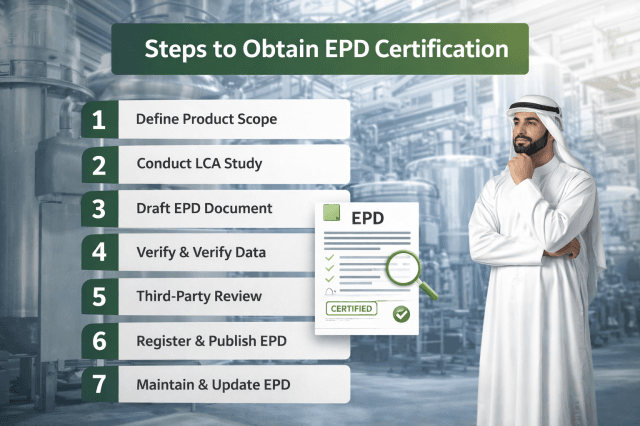
You've decided to get an EPD for your building products. Smart move. Now comes the part where most manufacturers stall—actually figuring out how to make it happen.
The process isn't complicated, but it does require coordination, data you might not have organized yet, and decisions about scope and standards. The manufacturers who breeze through EPD development are the ones who know what's coming and prepare accordingly.
This is your practical roadmap. No theory, no fluff—just the seven concrete steps that take you from "we should get an EPD" to holding a verified Environmental Product Declaration that opens doors across the GCC market.
Step 1: Choose Your Product and Define Your Scope
Before spending a dirham on consultants or LCA software, you need clarity on exactly what you're certifying.
Product Selection Strategy
Don't try to EPD your entire product line at once. Start with your highest-volume product or the one that gives you the most competitive advantage. Ask yourself:
- Which product gets specified most often on green building projects?
- Which product faces the most questions about environmental performance?
- Which product do competitors already have EPDs for?
- Which product represents the largest revenue opportunity?
For most GCC manufacturers, this means starting with core construction materials—your standard concrete mix, your most common steel profile, your flagship insulation product, or your primary facade system.
Scope Decisions
You'll need to decide on your LCA boundaries. The most common choice in the construction industry is "cradle-to-gate," which covers:
- Raw material extraction and processing
- Transportation of materials to your facility
- Manufacturing at your facility
- Packaging
- Transportation to the factory gate
This scope excludes installation, use phase, and end-of-life, which keeps complexity manageable for your first EPD while still providing the data that architects and specifiers need for material comparison.
Reality Check: Getting granular about scope now prevents expensive revisions later. Write down exactly which product variant you're certifying (including any specifications like strength grades, thicknesses, or compositions) and what life cycle stages you're including.
Step 2: Find the Right Product Category Rules (PCR)
Product Category Rules are the specific guidelines that ensure your EPD can be fairly compared to competitors' EPDs. Think of them as the rulebook for your product category.
PCR Research
Visit the International EPD System registry and search for PCRs relevant to your product. Common categories for GCC manufacturers include:
- Concrete and concrete products
- Steel and metal products
- Insulation materials
- Glass and glazing systems
- Flooring products
- Paints and coatings
- Mechanical and electrical equipment
If multiple PCRs could apply to your product, choose the most specific one. A PCR for "thermal insulation products" is better than a generic "construction products" PCR because it addresses the specific environmental considerations relevant to insulation.
When No PCR Exists
If you manufacture a product without an existing PCR, you have two options:
- Work with a Program Operator to develop a new PCR (expensive and time-consuming, but positions you as a category leader)
- Use a closely related PCR and clearly document any adaptations needed for your specific product
For your first EPD in the GCC market, option two is usually more practical unless you're a large manufacturer with resources to invest in PCR development.
Pro Tip: PCRs are publicly available documents. Download and read yours before engaging consultants. Understanding what data you'll need to collect saves time and money during the actual LCA phase.
Step 3: Gather Your Manufacturing Data
This is where the real work begins. Your Life Cycle Assessment requires detailed data about inputs, outputs, and processes. The better organized your data, the faster and cheaper your EPD development becomes.
Essential Data Categories
Raw Materials:
- Every material input and its quantity (per functional unit of product)
- Supplier locations for transportation calculations
- Recycled content percentages if applicable
- Pre-consumer vs. post-consumer recycled content distinctions
Energy:
- Total electricity consumption per functional unit
- Energy source breakdown (grid mix, on-site solar, generators)
- Natural gas, diesel, or other fuel consumption
- Thermal energy use in production processes
Water:
- Water intake volumes and sources
- Process water vs. cooling water
- Wastewater discharge volumes and treatment methods
- Water recycling or closed-loop systems
Emissions:
- Direct air emissions from manufacturing processes
- Dust and particulate matter
- Process-specific emissions (e.g., CO2 from cement calcination)
- Refrigerant losses if applicable
Waste:
- Solid waste generation by type
- Waste disposal methods (landfill, recycling, incineration)
- Hazardous waste if applicable
- Waste-to-energy if applicable
Transportation:
- Average distances for major raw material inputs
- Transportation modes (truck, rail, ship)
- Distribution distances to typical customers
Data Organization Tips
Create a spreadsheet with data per functional unit right from the start. If your functional unit is "one cubic meter of concrete," organize all your data accordingly. This prevents conversion errors and makes verification smoother.
For GCC manufacturers, pay special attention to energy data. The carbon intensity of electricity in the UAE or Saudi Arabia differs significantly from Europe or North America, so using local grid mix data makes your EPD more accurate and regionally relevant.
Common Data Gaps: Most manufacturers struggle with transportation distances (especially for multiple suppliers) and accurate waste data. Start collecting this information early, even if it requires estimates initially. You can refine estimates as you develop more sophisticated tracking systems.
Step 4: Select Your LCA Consultant or Software
You have two paths: hire a consultant to conduct your LCA and develop your EPD, or use LCA software and do it in-house with appropriate training.
The Consultant Route
For your first EPD, working with experienced EPD consultants makes sense. They bring:
- Knowledge of applicable PCRs and standards
- Access to LCA databases for background data
- Experience navigating verification requirements
- Relationships with verifiers and Program Operators
When selecting consultants, prioritize those with:
- Experience in your product category
- Understanding of GCC manufacturing contexts
- Portfolio of verified EPDs they've developed
- Clear communication about timeline and deliverables
Budget Expectations: Consultant-led EPD development in the GCC typically runs $15,000-$30,000 for straightforward products, potentially more for complex products with multiple components or significant data gaps.
The In-House Route
If you have technical staff with environmental engineering or sustainability backgrounds, LCA software like GaBi or SimaPro enables in-house development. This makes sense if:
- You plan to develop EPDs for multiple products
- You want ongoing capability to model product changes
- You have staff capacity to invest in LCA training
- You're comfortable with technical environmental assessment
Even with in-house capability, you'll still need third-party verification, but you save significant consulting fees on the LCA development phase.
Step 5: Conduct the Life Cycle Assessment
This is where your organized data transforms into quantified environmental impacts. Whether you're working with consultants or doing this in-house, the LCA process follows ISO 14044 standards and your selected PCR.
What Happens During LCA
Your consultant (or software) uses your primary data about manufacturing combined with background data from LCA databases for upstream processes like raw material extraction and energy generation. This creates a comprehensive model of your product's environmental profile.
You'll see results across multiple impact categories:
- Global Warming Potential (carbon footprint)
- Ozone Depletion Potential
- Acidification Potential
- Eutrophication Potential
- Photochemical Ozone Creation Potential
- Abiotic Resource Depletion
The LCA identifies which life cycle stages contribute most to each impact category—these are your environmental "hotspots" that guide future improvement efforts.
Iteration and Refinement
Expect back-and-forth. Your consultant will ask clarifying questions about processes, request additional data for significant inputs, and potentially flag areas where data quality needs improvement. This iteration is normal and actually strengthens your final EPD.
Timeline Reality: The LCA phase typically takes 6-8 weeks once all data is collected. If you're missing critical data, add time for collection. Rushing this phase compromises the quality and accuracy of your final EPD.
Step 6: Third-Party Verification
Your LCA data doesn't become an EPD until an independent verifier confirms it's accurate, complete, and compliant with relevant standards and PCRs. This verification is what gives your EPD credibility with architects, specifiers, and green building certification systems.
The Verification Process
An accredited verifier (independent from your consultant if you used one) reviews:
- Completeness and accuracy of your data
- Compliance with your selected PCR
- Adherence to ISO 14025 and ISO 14044 standards
- Transparency in methodology and assumptions
- Appropriate use of LCA databases and background data
- Calculations and modeling accuracy
Verifiers will ask questions and may request additional documentation or clarification. This isn't adversarial—they're ensuring the EPD meets standards that make it valuable and credible.
Verification Timeline and Cost
Plan for 2-4 weeks for verification after submitting your LCA report. Verification costs typically range from $3,000-$8,000 depending on product complexity and whether this is your first EPD or you're adding to an existing portfolio.
What Delays Verification: Incomplete data documentation, unclear assumptions, deviations from PCR requirements, or using inappropriate background data. The better organized your LCA documentation, the smoother verification proceeds.
Step 7: Registration and Publication
Once verification is complete, you register your EPD with a Program Operator—most commonly the International EPD System for GCC manufacturers pursuing international market recognition.
Registration Requirements
You'll submit:
- Your verified LCA report
- The formatted EPD document
- Verification statement from your verifier
- Registration fees (typically $500-$2,000 annually)
- Product specifications and manufacturer information
The Program Operator reviews everything one final time, assigns your EPD a registration number, and publishes it in their public registry.
Your Published EPD
Your finished EPD is a concise document (typically 8-15 pages) formatted according to Program Operator standards. It includes:
- Product description and specifications
- Declared functional unit
- Life cycle stages covered
- Environmental impacts across all required categories
- Additional environmental information
- Manufacturing location and contact information
- Verification statement and validity dates
This published EPD is what you share with customers, include in product literature, and reference when bidding on projects requiring environmental documentation for LEED or other certifications.
Validity Period: EPDs are typically valid for five years, after which they require reverification to ensure they reflect current manufacturing processes and environmental performance.
After Your EPD: Maximizing Value
Getting your EPD published isn't the finish line—it's the starting line for leveraging this investment:
Internal Communication
Train your sales team on what the EPD means, which projects it helps you win, and how to discuss environmental performance with customers. An EPD only creates value if your team knows how to use it.
Marketing Integration
Add your EPD to product pages, specification sheets, and marketing materials. Make it easy for architects and specifiers to find and download. Include the EPD registry link so they can verify its authenticity.
Project Targeting
Actively pursue projects requiring environmental documentation. Your EPD gives you access to opportunities competitors without EPDs can't compete for—but only if you're proactively identifying and bidding these projects.
Continuous Improvement
Use the environmental hotspots identified in your LCA to guide product and process improvements. When you reverify in five years, documenting measurable environmental improvement strengthens your market position.
Portfolio Expansion
Once you've successfully completed one EPD, developing EPDs for additional products becomes easier. You've built the data collection systems, understand the process, and have relationships with consultants and verifiers who know your operations.
Common First-Timer Mistakes
Mistake #1: Incomplete Data Collection Don't start the LCA process until you've gathered comprehensive data. Gaps discovered mid-process cause expensive delays and rework.
Mistake #2: Wrong PCR Selection Using an inappropriate PCR can invalidate your EPD or prevent fair comparison with competitors. Get this right at the beginning.
Mistake #3: Focusing Only on Carbon EPDs report multiple impact categories. Understanding your complete environmental profile—not just carbon footprint—reveals opportunities competitors might miss.
Mistake #4: No Internal Communication Plan Your EPD creates zero value if your sales and marketing teams don't know how to leverage it effectively with customers and projects.
Mistake #5: Treating It as One-Time Compliance EPDs should inform ongoing product development and continuous improvement, not just satisfy a procurement requirement once.
Budget and Timeline Summary
For a typical first EPD in the GCC:
Total Investment: $18,000-$38,000
- LCA development: $8,000-$20,000
- EPD formatting and documentation: $2,000-$5,000
- Third-party verification: $3,000-$8,000
- Program Operator registration: $500-$2,000
- Internal staff time: variable
Total Timeline: 4-6 months
- Scope definition and PCR selection: 1-2 weeks
- Data collection: 4-6 weeks
- LCA development: 6-8 weeks
- EPD documentation: 2-3 weeks
- Verification: 2-4 weeks
- Registration and publication: 1-2 weeks
These timelines assume you can dedicate appropriate resources and don't encounter major data gaps that require new data collection systems.
Final Thoughts
Getting your first EPD feels daunting from the outside, but it's a well-established process with clear steps and standardized requirements. The manufacturers who succeed are those who commit to thorough data collection upfront and view the EPD as a strategic investment rather than a compliance burden.
Start with one product. Master the process. Then expand to your broader product portfolio as you see the market advantage EPDs create in the increasingly sustainability-focused GCC construction market.