

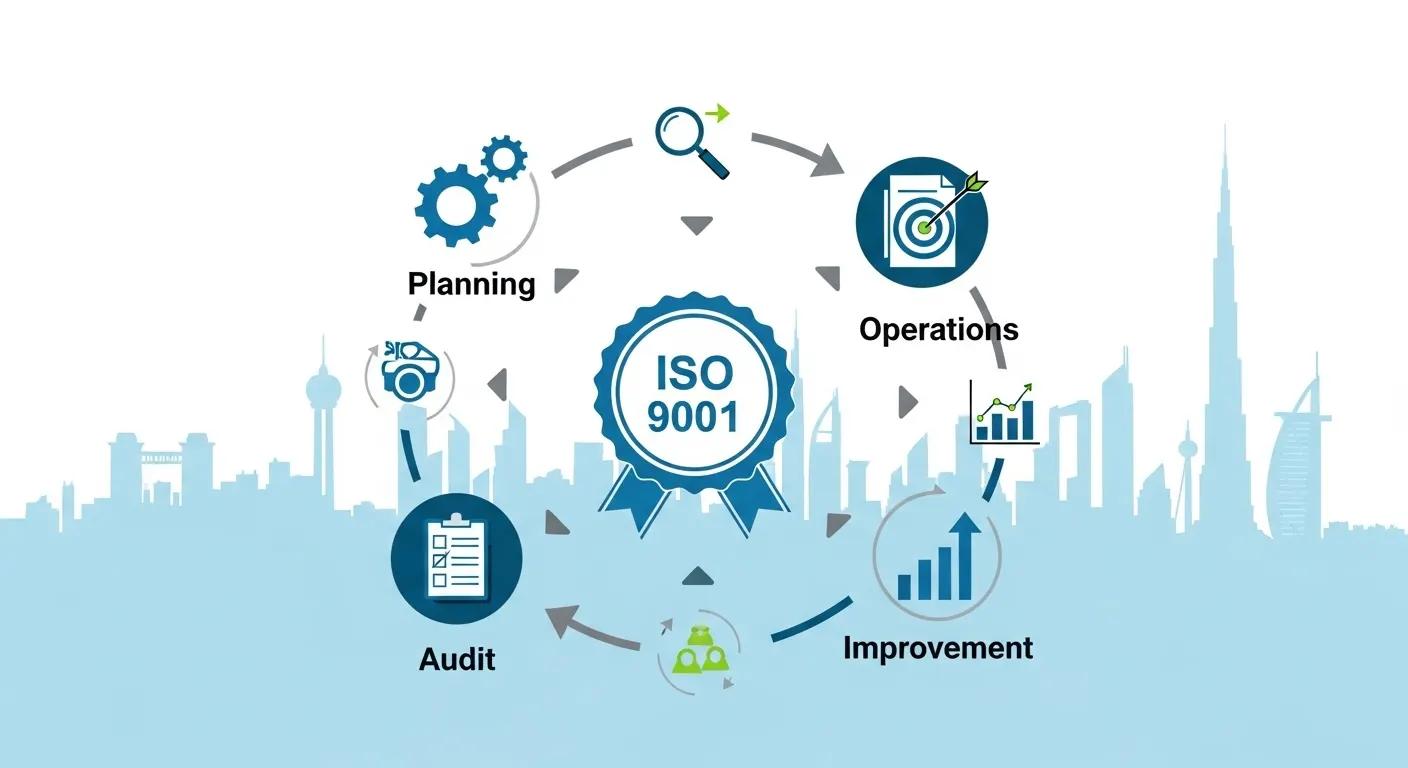
ISO 9001 Certification
In a world where consumers demand accountability and supply chains require trust at every link, achieving ISO 9001 certification is no longer a luxury — it is the benchmark that signals your organisation's commitment to excellence.
What Is ISO 9001 Certification?
ISO 9001 is the internationally recognised standard for Quality Management Systems (QMS), published by the International Organization for Standardization (ISO). It defines a framework of principles that help organisations consistently deliver products and services that meet customer and regulatory requirements.

At its core, the standard is built around seven quality management principles: customer focus, leadership, engagement of people, process approach, improvement, evidence-based decision making, and relationship management. Together, these principles create a culture of continuous improvement that permeates every level of an organisation.
Unlike many compliance frameworks that prescribe exactly what you must do, ISO 9001 certification is flexible enough to apply to any business — from a five-person startup to a multinational manufacturer — making it one of the most widely adopted standards in history.
Key Benefits for Your Business
Pursuing ISO 9001 certification delivers measurable advantages that extend well beyond hanging a certificate on the wall. Here is what organisations consistently report after achieving certification:
Improved operational efficiency — Documented processes reduce waste, rework, and costly errors across every department.
Stronger customer trust — Certification signals that quality is embedded in your operations, not just promised in a brochure.
Access to new markets — Many government tenders and enterprise procurement contracts now mandate ISO 9001 as a prerequisite.
Better supplier relationships — A certified QMS gives suppliers and partners confidence in your supply chain management.
Motivated workforce — Clear procedures and defined responsibilities reduce ambiguity and empower employees to take ownership of quality.
Risk reduction — The standard's risk-based thinking approach ensures potential issues are identified and mitigated before they escalate.
Did You Know?Studies by the British Standards Institution (BSI) indicate that ISO 9001-certified companies tend to outperform non-certified competitors in revenue growth and customer retention, largely because the certification enforces continuous improvement rather than a one-time fix.
The Step-by-Step Certification Process
The journey to ISO 9001 certification is a structured but achievable process. Here is a simplified roadmap to guide your organisation:
Gap Analysis — Assess your current processes against ISO 9001:2015 requirements to identify areas needing improvement.
Management Commitment — Secure buy-in from leadership; the standard requires top management to take ownership of the QMS.
Documentation — Develop your Quality Policy, Quality Objectives, and mandatory procedures.
Implementation — Deploy new processes across all relevant departments and conduct staff training.
Internal Audit — Run an internal audit cycle to verify compliance and find any remaining nonconformities.
Certification Audit — A certified body conducts a two-stage external audit (Stage 1: document review; Stage 2: on-site assessment).
Certification & Surveillance — Once awarded, your certificate is maintained through annual surveillance audits and a three-year recertification cycle.
How Long Does It Take and What Does It Cost?
Timelines and investment vary depending on organisation size and existing quality maturity. Typically, small-to-medium businesses achieve initial certification within three to six months, while larger enterprises may require nine to twelve months for full implementation.
Cost factors include consultancy fees, employee training, internal audit resources, and the certification body's fees. While these represent a real investment, most certified companies report that cost savings from reduced rework and improved efficiency deliver a positive return within the first year of certification.
Partnering with an experienced certification consultancy significantly shortens the journey and reduces surprises during your audit. The team at Global ISO Certificates offers end-to-end guidance — from initial gap analysis through to certification and beyond.
Who Should Pursue ISO 9001 Certification?
ISO 9001 is sector-neutral and size-neutral. Whether you operate in manufacturing, construction, healthcare, IT services, education, or professional services, the standard adapts to your context. Any organisation that wants to:
Demonstrate commitment to quality to customers and stakeholders
Compete in markets that require formal quality accreditation
Systematically reduce operational waste and inefficiency
Build a foundation for integrating other ISO standards (such as ISO 14001 or ISO 45001)
The standard is designed to grow with your business, ensuring quality remains central to your strategy as you scale.