

EPD vs. HPD vs. LCA: Choosing the Right Documentation for Your Building Material
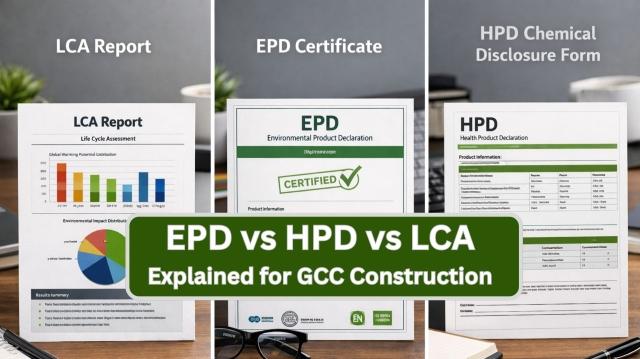
You're standing in front of a specification consultant who just asked for your product's "environmental documentation." You smile confidently and reach for your folder—then freeze. Do they want the EPD? The HPD? That LCA report you commissioned last year? And what's the actual difference between these acronyms anyway?
If you've been in this situation, you're not alone. The sustainable building industry has created an alphabet soup of documentation standards, and choosing the wrong one can cost you project opportunities, waste your budget, or worse—leave you without the documentation you actually need.
Let's cut through the confusion and help you understand which environmental documentation your building materials really need.
The Quick Version: What Each Document Actually Does
Before we dive deep, here's the essential difference in plain English:
LCA (Life Cycle Assessment) is the foundation—the comprehensive analysis of your product's environmental impact from raw materials through disposal. Think of it as the full environmental story of your product.
EPD (Environmental Product Declaration) is the verified, standardized report card based on your LCA. It's designed for comparing different products in the same category. This is what architects and engineers use to make informed material selections.
HPD (Health Product Declaration) doesn't care about carbon emissions or energy use. It focuses entirely on what chemicals are in your product and whether they might harm human health. This is about toxicity, not sustainability.
Here's the thing most manufacturers get wrong: you don't choose between these documents. You need different ones depending on what you're trying to achieve.
Life Cycle Assessment: Your Starting Point
Think of an LCA as the environmental biography of your product. It traces everything from mining the raw materials, manufacturing, transportation, installation, use phase, and eventually disposal or recycling.
What an LCA Measures
- Energy consumption at each life stage
- Water usage and pollution
- Air emissions including greenhouse gases
- Waste generation
- Resource depletion
- Impact on ecosystems
The key word here is comprehensive. A proper LCA following ISO 14044 standards looks at dozens of environmental indicators across multiple impact categories. It's detailed, data-intensive, and frankly, overwhelming if you're just trying to figure out what documentation to get.
When You Need an LCA
You need an LCA if:
- You're developing an EPD (it's the required foundation)
- You want to understand your product's true environmental footprint for internal decision-making
- You're redesigning products to reduce environmental impact and need baseline data
- Corporate sustainability reporting requires detailed environmental metrics
Here's what LCAs don't do: They don't create a document you can hand to an architect during product specification. LCA reports are technical, lengthy, and not designed for easy comparison between products. That's why EPDs exist.
The Reality Check
Conducting a proper LCA costs anywhere from $8,000 to $25,000 depending on product complexity and whether you're starting from scratch or have existing data. It takes 2-4 months of detailed data collection about your manufacturing processes, supply chain, and product composition.
But here's the value: once you have LCA data, you can use it for multiple purposes—creating EPDs, informing product development, supporting sustainability claims, and corporate ESG reporting. It's an investment that keeps giving returns.
Environmental Product Declarations: The Market Currency
If LCA is your product's environmental biography, the EPD is the executive summary that everyone actually reads. EPDs take that complex LCA data and present it in a standardized format that allows fair comparisons between competing products.
What Makes EPDs Different
EPDs follow strict rules called Product Category Rules (PCR) that ensure all products in the same category report environmental impacts the same way. This means architects can compare your concrete to a competitor's concrete, or your insulation to alternative insulation materials, using consistent metrics.
The magic of EPDs is standardization. Every EPD reports:
- Global Warming Potential (carbon footprint)
- Ozone depletion
- Acidification
- Eutrophication
- Photochemical ozone creation
- Resource depletion
All measured in standardized units, all following the same methodology, all verified by independent third parties.
When You Need an EPD
EPDs are essential if:
- You're selling to projects pursuing LEED, BREEAM, or Estidama certification
- Government tenders require verified environmental documentation
- Architects and specifiers ask for quantified environmental performance data
- You want to demonstrate lower environmental impact than competitors
- You're targeting the premium sustainable construction market in the GCC
Real talk: In 2025, if you manufacture construction materials and don't have an EPD, you're being eliminated from specifications before price discussions even begin. It's that simple.
The EPD Process
Getting an EPD requires four steps:
- Conduct or update your LCA
- Format the data according to relevant PCR
- Submit for third-party verification
- Register with a Program Operator
The entire process takes 4-6 months and costs $15,000-$30,000 including LCA development and verification. EPDs remain valid for five years, meaning you're spreading that investment across dozens or hundreds of potential projects.
Health Product Declarations: The Human Health Angle
Now we shift gears completely. HPDs have nothing to do with carbon emissions or resource depletion. They're entirely focused on chemical transparency and human health impacts.
What HPDs Actually Report
An HPD is essentially an ingredient label for building materials. It discloses:
- Every chemical substance in your product above certain thresholds
- Concentrations of each substance
- Associated health hazards based on authoritative lists
- Whether substances are known carcinogens, reproductive toxins, respiratory sensitizers, etc.
The goal is transparency about what's in products that people will live and work around. This matters because buildings shouldn't make people sick.
When You Need an HPD
HPDs become critical when:
- Your products are used in interior spaces where occupant health is a priority
- Projects are pursuing LEED credits for material ingredient disclosure
- Architects specify "Red List Free" materials (products avoiding the worst chemical offenders)
- You're selling to health-focused markets like schools, hospitals, or wellness-branded developments
- You want to demonstrate that your products don't contain substances of concern
Here's the distinction: If your product is structural steel, an EPD matters much more than an HPD. If you manufacture interior paint, flooring, or furniture, you probably need both—EPD for environmental impact, HPD for health transparency.
The HPD Reality
HPDs are generally faster and less expensive than EPDs—typically $3,000-$8,000 and completed in 2-3 months. However, they require detailed knowledge of your product's chemical composition, which sometimes means going back to raw material suppliers for ingredient disclosure.
Some manufacturers discover through the HPD process that their products contain substances they'd rather avoid. This can trigger product reformulation, which is actually valuable information to have before a customer or regulator identifies the issue.
Choosing Your Documentation Strategy
Here's how to think strategically about which documentation to pursue:
For Structural Materials (Concrete, Steel, Aluminum)
Priority 1: EPD—this is what gets you specified on major projects Priority 2: LCA (if not already done for the EPD) Priority 3: HPD—less critical unless you're dealing with specialty treatments or coatings that might contain substances of concern
For Interior Finishes (Flooring, Paint, Ceiling Tiles)
Priority 1: HPD—occupant health is the primary concern Priority 2: EPD—increasingly required for green building credits Priority 3: LCA—useful for your own product development but not typically requested
For Facade Systems and Insulation
Priority 1: EPD—these materials have significant embodied carbon and energy performance implications Priority 2: HPD—especially for insulation where off-gassing could affect indoor air quality Priority 3: LCA—the foundation for your EPD
For MEP Components
Priority 1: EPD—mechanical and electrical systems represent major embodied carbon and operational energy Priority 2: Consider both depending on specific products—some MEP items have more health relevance than others
The Combination Approach
Smart manufacturers are pursuing both EPDs and HPDs simultaneously because green building certifications increasingly reward comprehensive transparency. LEED v4.1, for example, offers separate credit pathways for environmental impact (EPDs) and health transparency (HPDs).
This combination approach positions your products for maximum market access. You can respond to any specification requirement—environmental, health, or both.
The efficient way to do this: Start with your LCA, develop your EPD, then tackle the HPD while that momentum is going. Many of the organizational systems you build for LCA data collection transfer to HPD development.
Common Mistakes to Avoid
Mistake #1: Getting an HPD when you need an EPD These documents serve different purposes. An HPD won't satisfy environmental documentation requirements for government tenders or sustainability certifications focused on carbon reduction.
Mistake #2: Thinking an LCA is enough Your detailed LCA report is great for internal use, but it's not what architects or certification systems require. You need the standardized EPD format for market applications.
Mistake #3: Generic industry EPDs instead of product-specific Industry-average EPDs are better than nothing, but product-specific EPDs give you competitive advantage if your environmental performance beats the industry average.
Mistake #4: Skipping verification Unverified environmental claims might work in marketing materials, but they don't count for green building certifications or government procurement. Third-party verification is non-negotiable.
Mistake #5: Letting documentation expire Both EPDs and HPDs have validity periods. Tracking expiration dates and planning for updates keeps you continuously eligible for projects rather than scrambling when opportunities arise.
Budget Planning Reality
Let's talk numbers honestly. For a comprehensive documentation package:
- Initial LCA: $8,000-$25,000
- EPD development and verification: $7,000-$15,000 (less if LCA already exists)
- HPD development: $3,000-$8,000
- Total initial investment: $18,000-$48,000
This seems like a lot until you consider:
- Documentation remains valid for 5 years
- Single project wins often exceed the entire documentation investment by 100-1000x
- Growing number of projects require this documentation just to be considered
- Competitive advantage as competitors without documentation get eliminated from specifications
Think of it as market access investment, not marketing expense. Without proper documentation, you're invisible to an increasingly large portion of the high-value sustainable construction market.
Final Thoughts
The complexity of environmental documentation reflects the construction industry's serious evolution toward genuine sustainability. Yes, it's more complicated than it used to be. But that complexity creates opportunities for manufacturers who embrace transparency while competitors resist change.
Start with understanding what your target market actually requires. Talk to architects, specifiers, and project teams you want to work with. Ask what documentation they need. Then build your strategy from there rather than guessing.
And remember: LCA, EPD, and HPD aren't competing options—they're complementary tools that together demonstrate your commitment to environmental and human health. The manufacturers winning premium projects in 2025 have all three.